Smart buildings have evolved tremendously in recent years. Today, they are capable of generating more data, integrating more systems, and providing more information than ever before. However, many of the assumptions we continue to take for granted about them are not necessarily true. In this article, we debunk five widely held beliefs that, far from helping, may actually be limiting the true potential of the buildings of the future. Because connecting a building is just the beginning; making it truly smart is much more complex.

For years, we have associated a building’s intelligence with the amount of technology installed: more sensors, more screens, more alarms, and more data.
But a building isn’t smart just because it’s connected.
This is the case when it uses information to anticipate trends, optimize its operations, and facilitate better decisions.
Here are five ideas that are still holding back the evolution of many buildings.
1. “The more data we have, the greater our control will be.”

Today’s buildings can generate thousands of data points every minute: temperatures, energy consumption, CO₂ levels, equipment status, schedules, alarms, and setpoints.
However, gathering information does not guarantee an understanding of what is happening.
When data is scattered across different systems, platforms, and dashboards, the result is often the opposite: more noise, more time spent on analysis, and greater difficulty in making decisions.
True value lies not in collecting data, but in turning it into understandable and actionable information.
A smart building shouldn’t just show what’s happening. It should help identify what needs attention and what action should be taken.
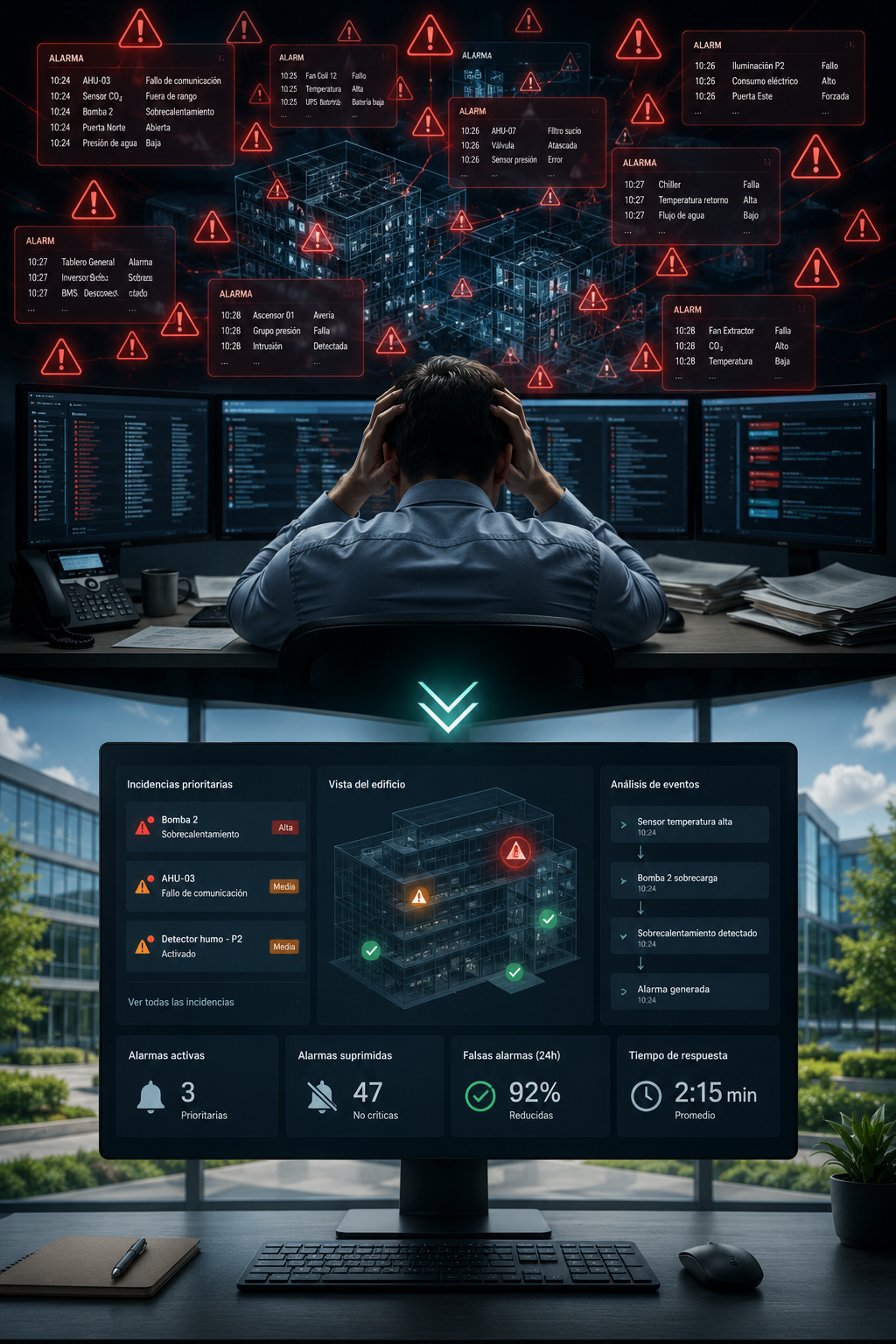
2. “The more alerts we receive, the safer we’ll be.”
An alert is only useful when it reaches the right person, at the right time, and with enough context.
In many buildings, operators receive hundreds of alerts, many of which are duplicates, irrelevant, or caused by the same incident.
This overload leads to alarm fatigue. When everything seems urgent, nothing really is.
Operational safety does not depend on the number of notifications, but rather on the system’s ability to:
- Prioritize incidents.
- Link events.
- Reduce false alarms.
- Provide a prompt response.
The difference between a warning and an effective decision lies in the context.
3. “A connected building is already a smart building”

Connecting HVAC, lighting, power, access control, and other systems is an important step, but it is not the end goal.
A building can have thousands of connected devices and still operate in a fragmented manner.
If each system operates in isolation, information remains scattered, tasks continue to be performed manually, and opportunities for optimization remain hidden.
Intelligence emerges when systems share information, coordinate with one another, and function as a single infrastructure.
It’s not just about connecting devices. It’s about connecting decisions.
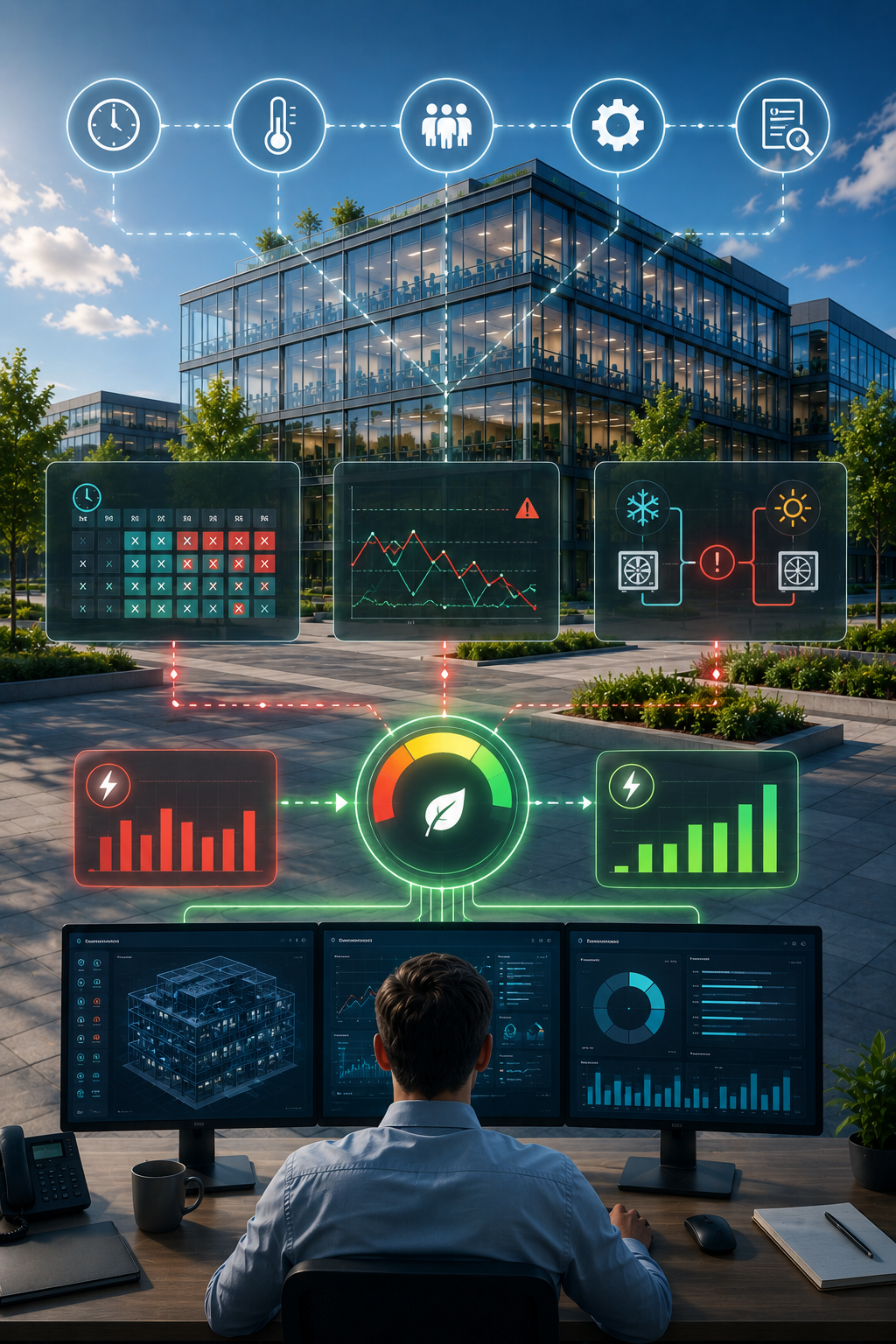
4. “Installing a BMS ensures energy efficiency”
A building management system is an essential tool, but simply installing it does not guarantee a reduction in energy consumption.
Efficiency depends on how it is configured, maintained, and used.
Incorrect schedules, inappropriate setpoints, equipment operating outside of occupancy hours, or facilities running both heating and cooling simultaneously can turn an advanced system into a source of inefficiencies.
To improve energy efficiency, it is necessary to continuously analyze the building’s performance and identify deviations before they become recurring costs.
Technology creates opportunities. Continuous optimization generates savings.
5. “A dashboard provides all the necessary visibility”

Dashboards have greatly improved the way we visualize a building. But a screen full of graphs doesn’t always make it easier to understand.
Presenting information is not the same as explaining what it means.
The person in charge of a facility should not have to spend hours comparing curves, reviewing historical data, and looking for correlations between systems to figure out why consumption has increased or which piece of equipment is causing an anomaly.
The next generation of smart buildings will need to go beyond visualization.
You will need to interpret the data, identify the likely causes, and help prioritize actions.
True intelligence begins after the connection is made
The buildings already generate enough data.
The challenge now is to make that data work in favor of the people who manage, maintain, and use these spaces.
The future does not belong to buildings with more sensors, more alarms, or more graphics.
He is one of those capable of transforming all that information into comfort, efficiency, prevention, and better decisions.
Because a connected building can tell us what’s happening. A truly smart building should help us understand why.