

The complete probe
Adquio LoRa Multi Sensors
Adquio LoRa Multi Sensors is a compact device that integrates Temperature, Humidity, CO2 and VOC (Volatile Organic Compounds) probes. It uses LoRa technology for its connection, which allows for outstanding wireless communication inside buildings, penetrating walls and ceilings without major problems.
It is fed with alternating current in its two terminal blocks. Not only that, but it is multirange to be able to adapt to any country, with support from 100 to 250V and both 50 and 60 Hz.
Its main features are: small size and reliability. This probe requires a receiver, which is connected via Modbus RTU to any Adquio or other controller that supports this protocol.
Adquio LoRa Multi Sensors
TECHNICAL DATA
How to open it
The Adquio Ecosystem probes have the connections internally, this allows that once installed the box is completely clean and free of cables.
Therefore, in order to connect it both electrically and to the LoRa network, it is necessary to open it, and to do so, you only need to use a flat screwdriver (no larger than 2.5 mm in diameter) by placing it in the position provided for this purpose, and pull up the top cover.

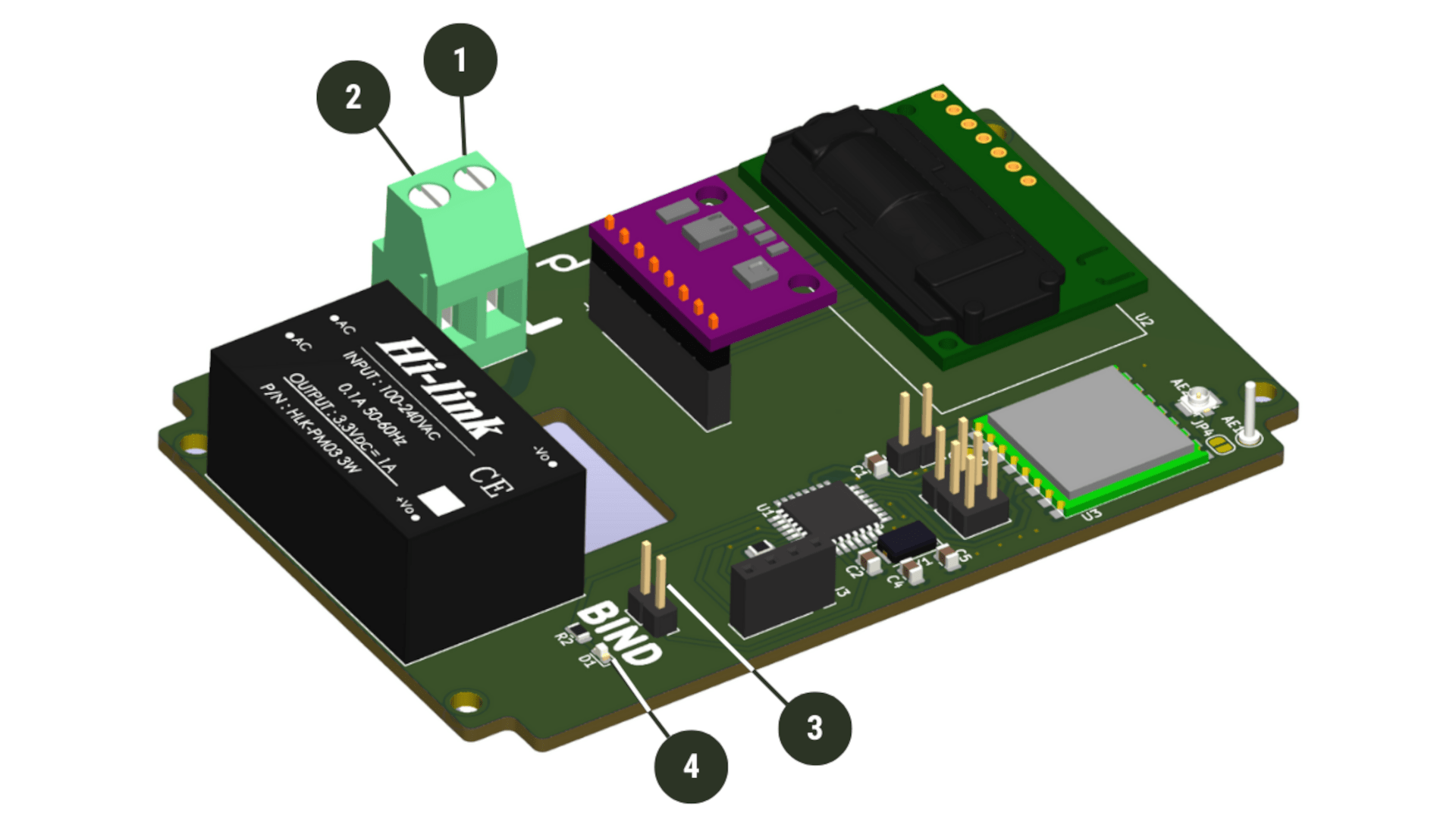
What you should know about its interior
Adquio LoRa Multi Sensors carries the connections for AC power wiring. This allows for easy installation in any location, as you can power it from the nearest point.
These are the values of the connectors:
- AC phase power supply terminal from 100 to 250V, 50 or 60 Hz.
- Alternating current neutral supply terminal, 100 to 250V, 50 or 60 Hz.
- Link jumper. You will receive your probe with a Jumper, but it will be disconnected. If you connect it, you will put the probe in link mode with the receiver.
- Link confirmation LED. It turns on steady when you set the jumper, this may take up to a minute, as the probe will be in sleep mode. Once this time has elapsed, the LED will light up and blink once, indicating that the pairing message has been sent. When paired correctly, this LED will blink 4 times in a row. Once this happens, you must remove the jumper you had connected in the previous step.
Certifications
Safety and Health
EN ISO 13849-1: 2015
EN ISO 13849-2: 2012
EN 62061: 2005 + A1: 2013 + A2: 2015
EN 60950-1: 2006
EN 62311: 2008
EMC
EN 61000-6-4: 2007 + A1: 2011
EN 61000-6-2: 2005
RoHS
EN 50581:2012
