Your building has lighting, heating and cooling, electrical systems, sensors and possibly security systems. But who makes sure they all work together?
Imagine an office building. At seven in the morning, the heating starts. At eight, the lights come on. At nine, employees arrive.
Yet an empty meeting room still has its air conditioning running. On another floor, the lights stay on all night. And nobody notices that an HVAC unit has been using more energy than usual for several weeks.
Each system works independently, with no awareness of what the others are doing.
This is where a BMS comes in.
First, what does BMS mean?
BMS stands for Building Management System.
Although the name may sound complicated, the idea is simple:
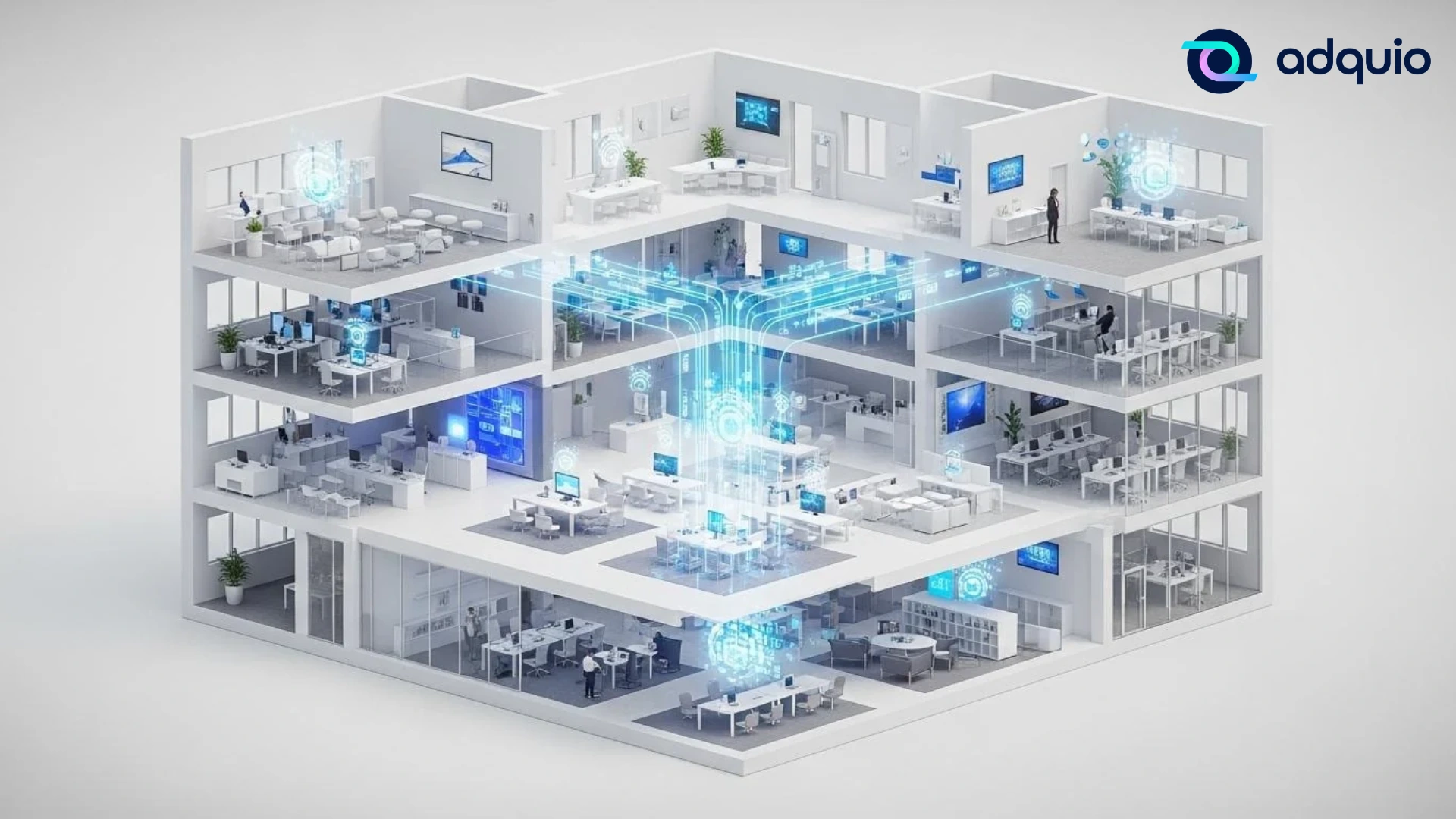
A BMS is a system that lets you monitor, control and coordinate a building’s technical installations from one place.
You could compare it to a building’s brain.
Our bodies have different organs, each with its own role, but all working together. Similarly, a BMS connects a building’s technical systems and allows them to work as a coordinated whole.
For example:
- Lighting can respond to the presence of people.
- Heating and cooling can adjust to temperature and occupancy.
- Electricity consumption can be measured and analysed.
- A fault can trigger an alert before it becomes a major problem.
- The building manager can see what is happening without travelling to the site.
All of this can be managed from a computer, a touchscreen or, depending on the solution, a mobile phone.
A simple example: a hotel
Imagine a hotel with 100 rooms.
Without centralised management, each room may have its own thermostat, switches and equipment. Staff have to check many things manually, and getting an overall view of the building is difficult.
Now imagine the same hotel with a BMS.
When a guest leaves their room, the system can receive that information and automatically reduce heating or cooling.
When they return, the temperature can be brought back to a comfortable level.
If a room has an unusual temperature or a piece of equipment stops responding, maintenance receives a notification.
Reception staff can check the status of the installations without walking around the building.
And management can see how much energy is being used, in which areas and at what times.
The building is the same. What changes is its ability to operate intelligently.
Of course, these features depend on the installed equipment and the integrations available.
What can a BMS actually control?
More than you might think.
Lighting
Automatically switch lights on or off, dim them, create schedules, adjust lighting to daylight levels or detect empty spaces.
Heating, cooling and ventilation
Monitor heating, air conditioning and ventilation, adjust temperatures and prevent equipment from running unnecessarily.
Energy
Understand electricity consumption, detect anomalies, compare periods and identify opportunities to reduce costs.
Air quality
Monitor variables such as temperature, humidity or CO₂ concentration and, where the necessary integration is available, control ventilation.
Alarms and maintenance
Detect equipment faults, disconnected devices or abnormal conditions and notify the people responsible.
Other building systems
Depending on the project, a BMS can also integrate blinds, pumps, tanks, access control and other technical installations.
The key is not simply to control more things, but to help systems share information and work together.
When does a building actually need a BMS?
This is probably the most important question.
And the answer may surprise you:
It is not just about the size of the building. It depends on its complexity, its installations and what you need to manage.
A small building with complex installations can benefit greatly from a BMS, while a larger one with very simple systems may need a less sophisticated solution.
Several signs suggest it is time to consider one.
1. When energy consumption becomes a problem
If your bills are high but you do not know exactly where, when or why so much energy is being used, you need information.
A BMS can help you obtain it and, through suitable automation and adjustments, reduce unnecessary consumption.
You cannot improve what you do not understand.
2. When you have too many independent systems
Lighting has its own app. Heating and cooling use another. Electricity meters have a different program. And alarms arrive through a separate channel.
If you need to check five different systems to understand what is happening in your building, centralising management can make the work much simpler.
3. When maintaining the building takes too much effort
Does your maintenance team constantly walk around the site to check that everything is working?
Are faults only discovered when someone complains?
A BMS makes supervision easier and helps identify many problems before they affect users.
4. When you manage several buildings
Imagine a company with ten offices, a chain with twenty shops or a hotel group with several properties.
A BMS with multi-building management capabilities lets you check all those installations from a common platform.
You can do more than confirm that they are working: you can compare consumption, identify differences and improve their operation.
5. When you want to improve people’s comfort
An efficient building should also be a comfortable one.
The right temperature, suitable lighting and good air quality directly affect the experience of the people using its spaces.
A BMS helps you find the balance between comfort and efficiency.
6. When you need to meet specific regulatory requirements
European energy efficiency legislation is driving the adoption of building automation and control systems in certain buildings.
In some cases, these capabilities are therefore a regulatory requirement as well as an opportunity for improvement.
Is installing a BMS mandatory?
Not in every building.
The European Energy Performance of Buildings Directive (EPBD), updated in 2024, sets automation and control requirements for certain non-residential buildings.
Its provisions include:
- Non-residential buildings with heating or air-conditioning systems with an effective rated output of more than 290 kW, with a reference date of 31 December 2024.
- Non-residential buildings with heating or air-conditioning systems with an effective rated output of more than 70 kW, with a deadline of 31 December 2029.
These requirements are subject to the technical and economic feasibility conditions set out in the legislation and to implementation in each country.
It is important to understand that 70 kW does not refer to the building’s total electricity consumption, but to the effective rated output of the thermal systems covered by the Directive.
The legislation also requires specific monitoring, recording, analysis, control and interoperability capabilities. Installing any software that displays data is not enough.
If you manage a commercial building, hotel, hospital, office or another non-residential facility, it is therefore worth checking which requirements apply.
Regulatory source: Directive (EU) 2024/1275, Article 13(9) and (10).
What if my building is old? Do I have to replace every installation?
This is one of the most common questions.
The good news is that installing a BMS does not necessarily mean replacing the equipment you already have.
Many buildings have lighting, HVAC and metering systems that work perfectly well but are not connected to one another.
Communication technologies and protocols such as Modbus, BACnet, KNX and DALI make it possible to integrate many devices from different manufacturers.
With the right solution, you can use much of the existing infrastructure and gradually add new capabilities.
You do need to assess which devices can communicate, which need a gateway and which require adaptations.
Making a building smarter does not always start with a major refurbishment. Sometimes it simply starts by connecting what is already there.
Is a BMS the same as home automation?
They have similarities, but they are not exactly the same.
Home automation usually focuses on automating functions within a home: lighting, blinds, heating and cooling, or scenes.
A BMS takes a broader approach to managing installations, their consumption, operation and maintenance together.
It can also provide analytics, alarms, centralised monitoring and multi-building management.
The difference lies in the level of management needed as well as the size of the installation.
Is a BMS expensive to install?
It depends on what you want to achieve.
Monitoring energy consumption and HVAC in a small business does not cost the same as integrating every installation in a hospital or large shopping centre.
But one point is fundamental: a BMS does not have to be installed all at once.
You can start with the most important systems, assess the results and gradually introduce more features.
For example, start by measuring energy, move on to HVAC control and later expand to lighting, alarms or maintenance.
The investment should be assessed against costs, potential savings, operational needs and improvements in comfort.
A good project focuses on the technology that actually adds value.
How can Adquio help?
At Adquio, we believe buildings should not consist of isolated systems that cannot communicate.
That is why we have developed a technology ecosystem that connects, monitors, controls and analyses different installations, making use of existing equipment wherever possible.
Our controllers can integrate devices and technologies from different manufacturers.
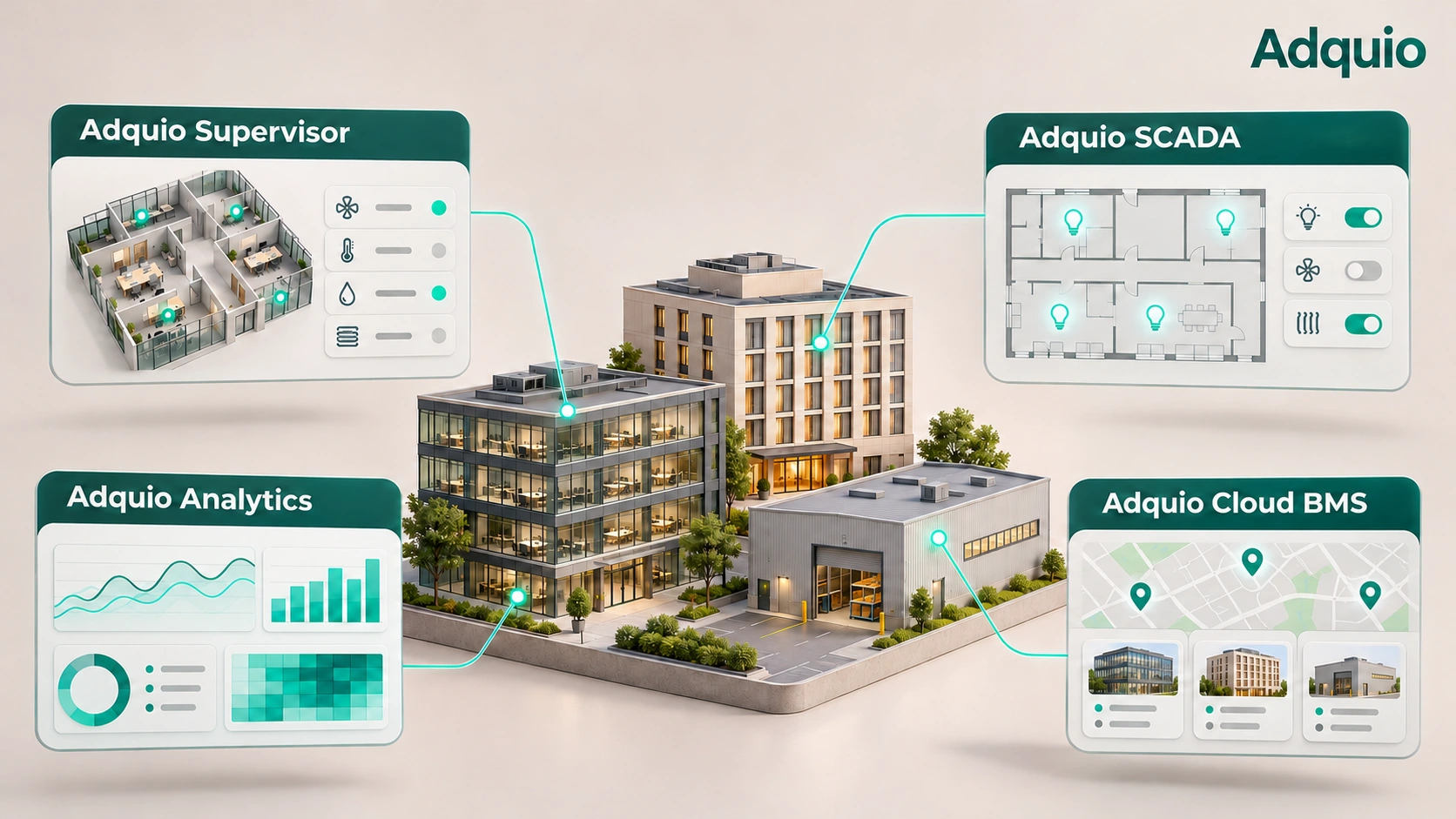
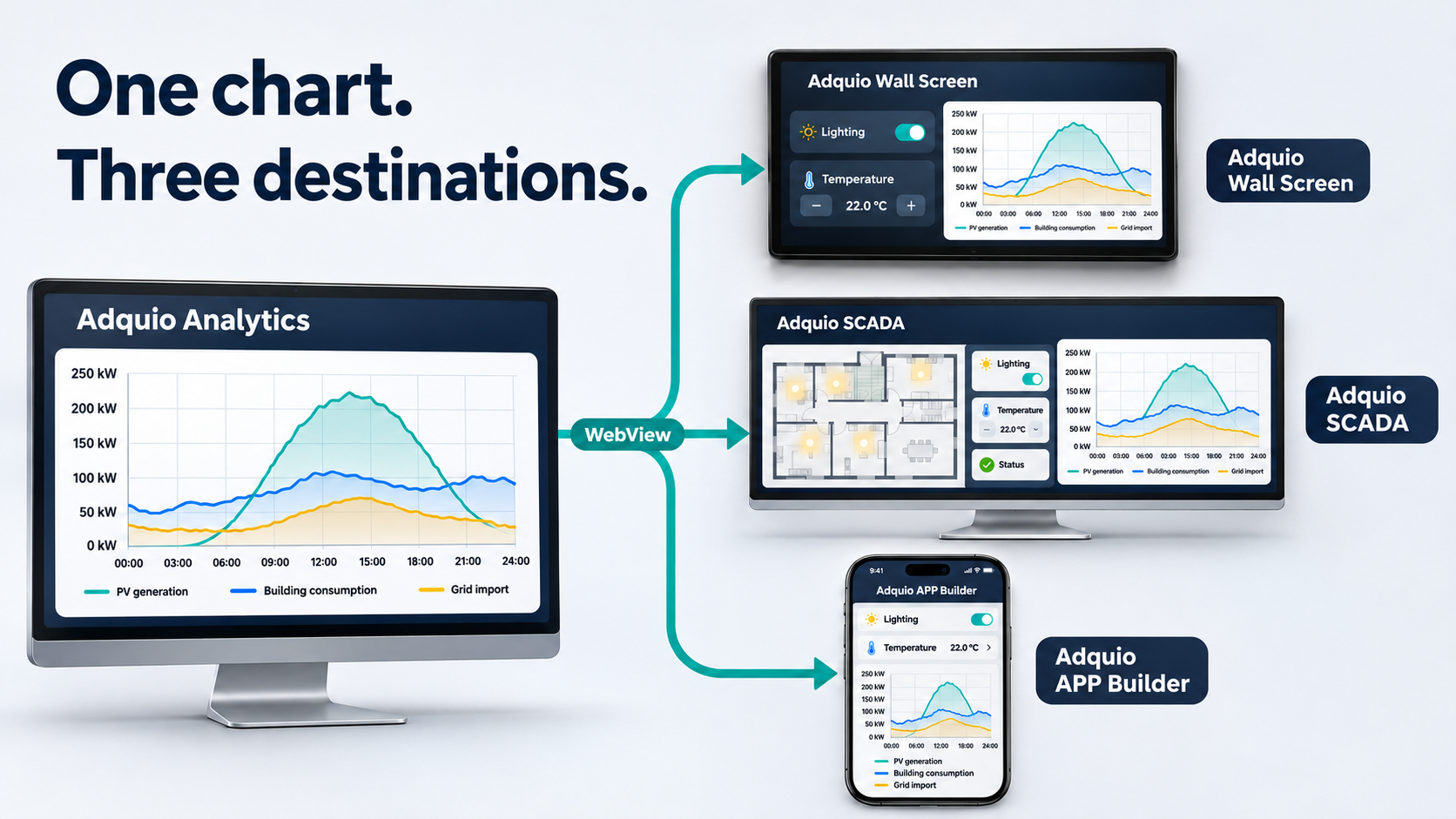
With Adquio SCADA, you can visualise and control installations through interfaces tailored to each building.
Adquio Analytics turns data into charts, indicators and useful information to help you understand how installations operate.
And Adquio Cloud BMS centralises the management of multiple buildings, lets you compare installations and provides monitoring from a common platform.
These are complementary solutions that can be combined to meet the needs of each project.
From a small installation to an organisation with buildings in different cities or countries, the goal is the same: turn existing data and systems into a useful tool for better management.
So, does my building need a BMS?
Ask yourself these five questions:
- Do I know exactly how much energy my building uses and where it is consumed?
- Can I check the status of its installations without walking around the site?
- Can my lighting, HVAC and energy systems share information?
- Can I detect problems before they cause breakdowns or inconvenience?
- Can I manage the building easily, even when I am not there?
If you answered “no” to several of them, it is probably worth exploring what a BMS could do for your building.
That does not necessarily mean you need a complex or expensive solution. It means there is an opportunity to improve how it operates.
The building of the future does not have to be new. It has to be smart.
For a long time, we have added technology to buildings as independent installations: one for lighting, another for HVAC, another for metering and another for security.
Today, we can take the next step.
We can make those installations communicate, use information to make better decisions and enable the building to respond automatically to people’s needs.
A smart building is one that makes better use of the technology it has.
And that is precisely the purpose of a BMS.
Would you like to discover what a BMS could do for your building?
At Adquio, we can help you assess your installations, identify integration opportunities and find a solution that fits your needs.
You do not need to replace everything to start making improvements.
Let’s discuss your building
Tell us which installations you want to connect and what you would like to improve.