How controller data reaches the rest of the Adquio ecosystem
When a light level changes, the operator expects to see it on the SCADA floor plan. With a Modbus TCP integration that polls periodically, the change appears on the next read. Many reads return the same value because nothing has changed. Adquio RAP works by events. After the initial read, the controller sends each change to the subscribed applications as soon as it detects it. This changes both what the operator sees and how the integrator configures the installation.
How applications communicated over Modbus TCP
With Modbus TCP, the client requests register values or binary states from the device. To interpret the response, it needs an address map that shows where each value is stored and how to read it. To display a light level, for instance, the integrator needs to know which register to read and how to scale the value to a percentage.
To keep the floor plan up to date, SCADA repeats these requests at a configured interval. More frequent polling can shorten the wait before a change appears, while increasing the number of requests, including reads that return an unchanged value. Less frequent polling reduces the number of requests, but the operator may see changes later. Reading contiguous registers in a single block helps reduce the number of requests.
How Adquio RAP works
Adquio RAP lets an application discover the devices and variables available on the controller and select the ones it needs. SCADA can select a light’s variable by its code and use it directly, without importing or converting it. It reads the initial value and subscribes to changes. The controller then sends updates for the selected variables over the TCP connection as they occur.
The controller applies the subscription filter. A screen monitoring one floor can receive updates for that floor alone. In a 15-second internal test, a RAP subscription limited to four variables received 681 bytes. A RAP subscription to the full catalogue received 22,279 bytes. Traffic at each site depends on the number of variables selected and how often they change.
RAP can also write to variables that support it. When the operator adjusts a lighting zone, the controller confirms whether it accepted the command, and SCADA can display the resulting state it receives. If the connection drops, the SCADA RAP client reconnects and restores the subscription.
What this means for the Adquio ecosystem
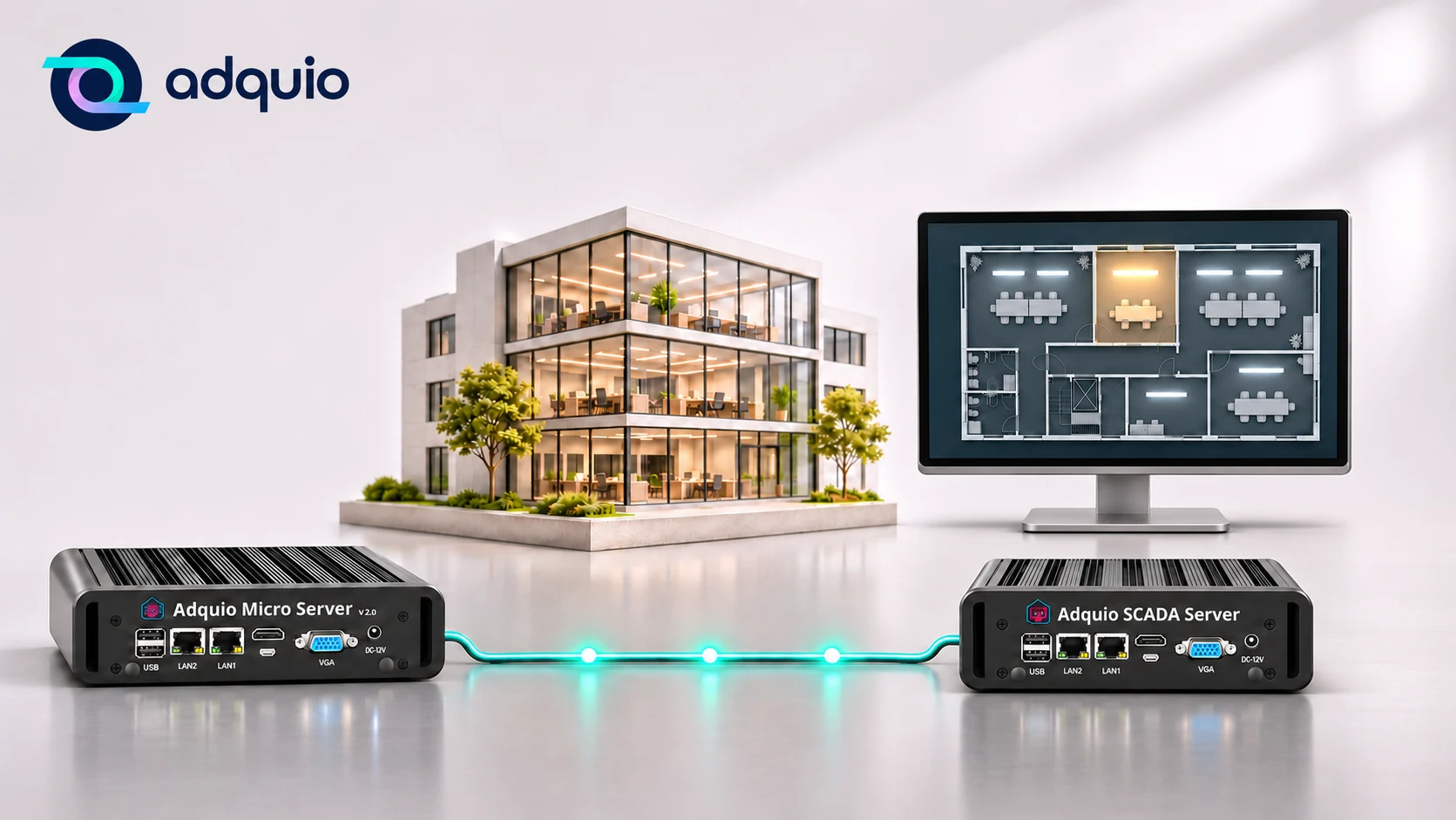
The controller’s catalogue gives applications a common reference. In Adquio SCADA Server and Adquio SCADA Cloud, the integrator selects the variables needed for floor plans, alarms and historical data. Adquio Supervisor can retrieve controller statistics through the same interface. Adquio KNX Gateway and Adquio MatterLink can also use RAP to access the variables they need for their respective integrations.
A shared catalogue reduces the work of maintaining separate register maps and makes it easier to trace a variable from the controller to the application that uses it. Field devices integrated over Modbus TCP can continue using that protocol. RAP improves the connection between the Adquio controller and the applications used to monitor and operate the installation.