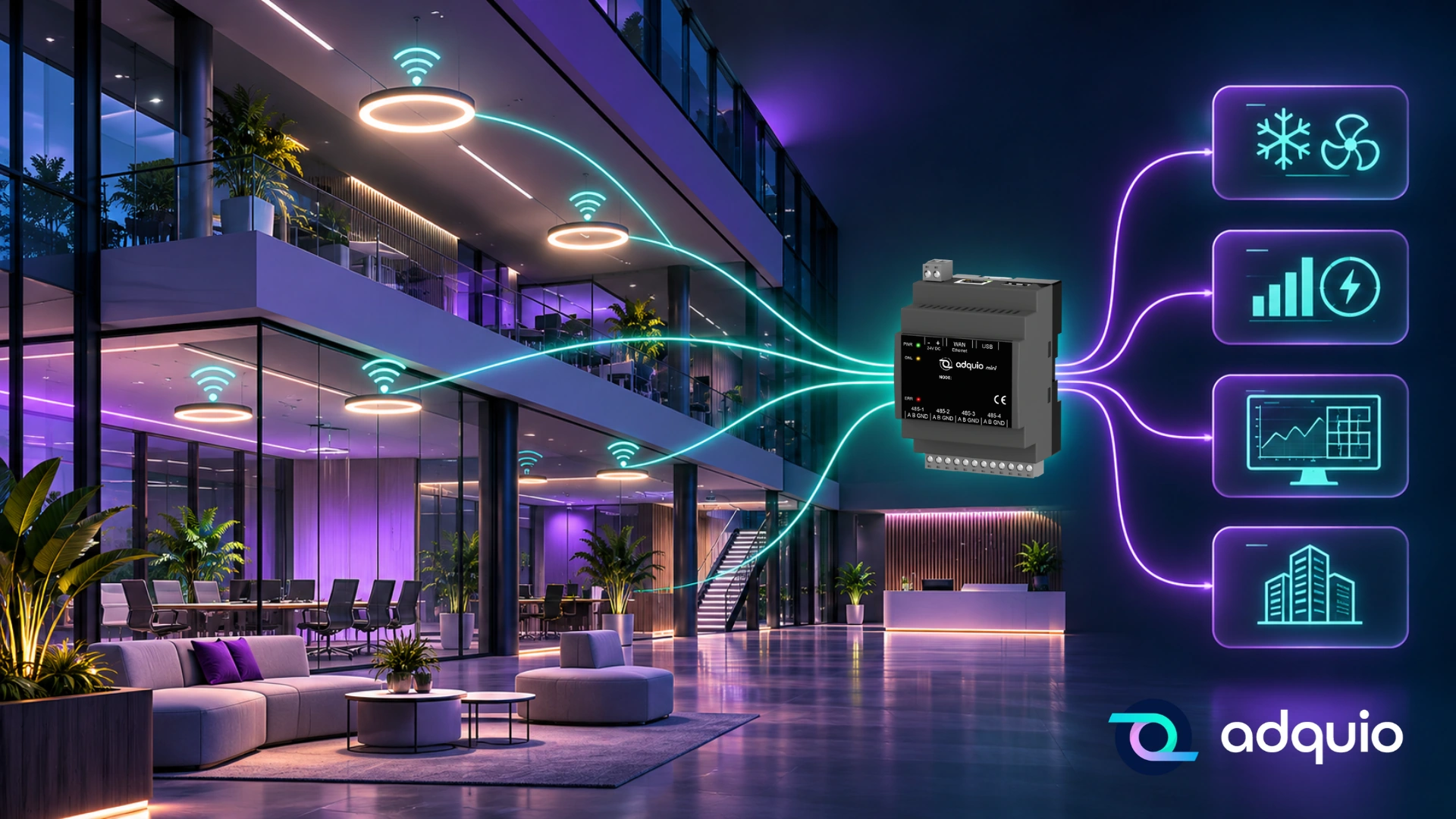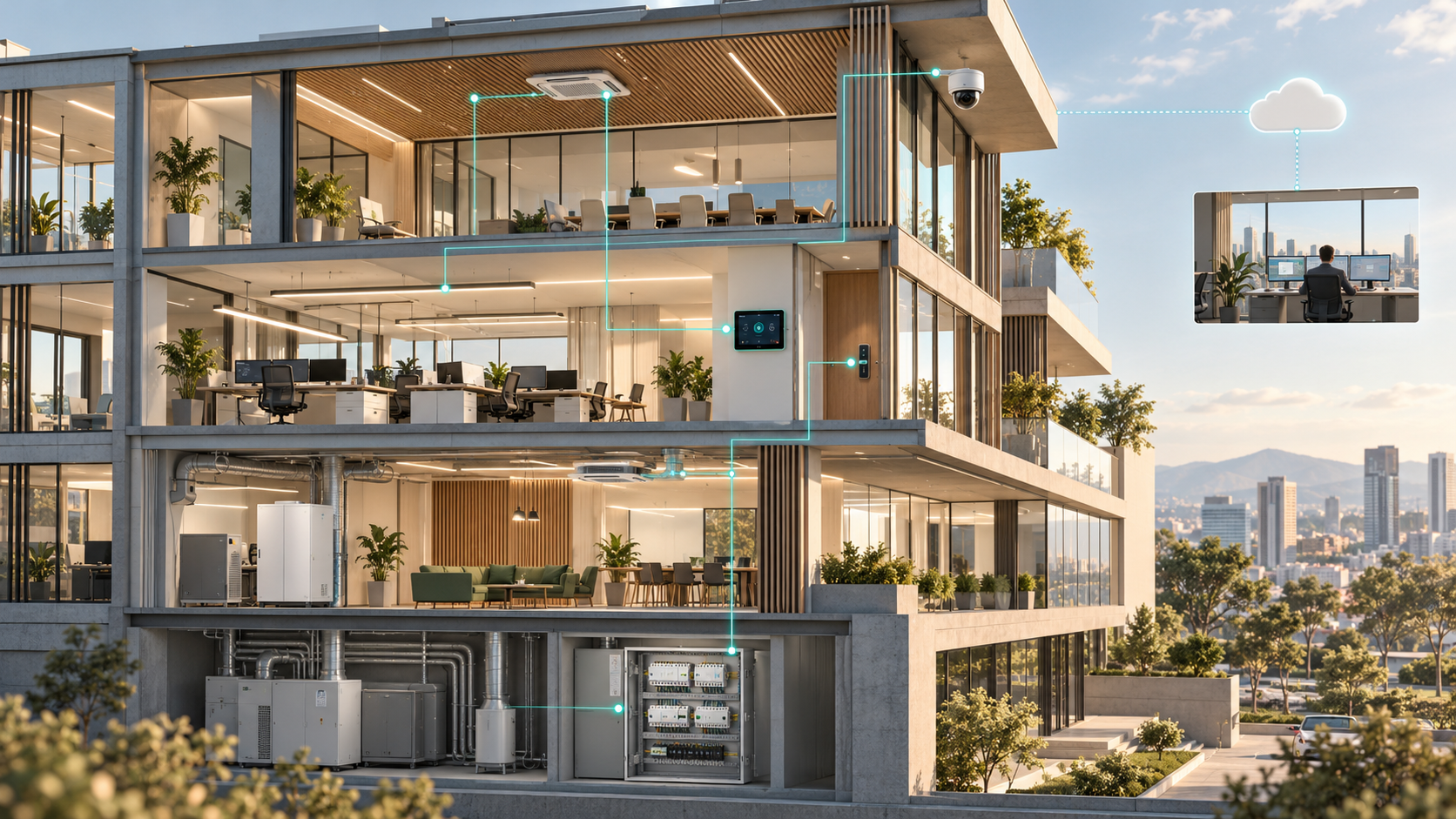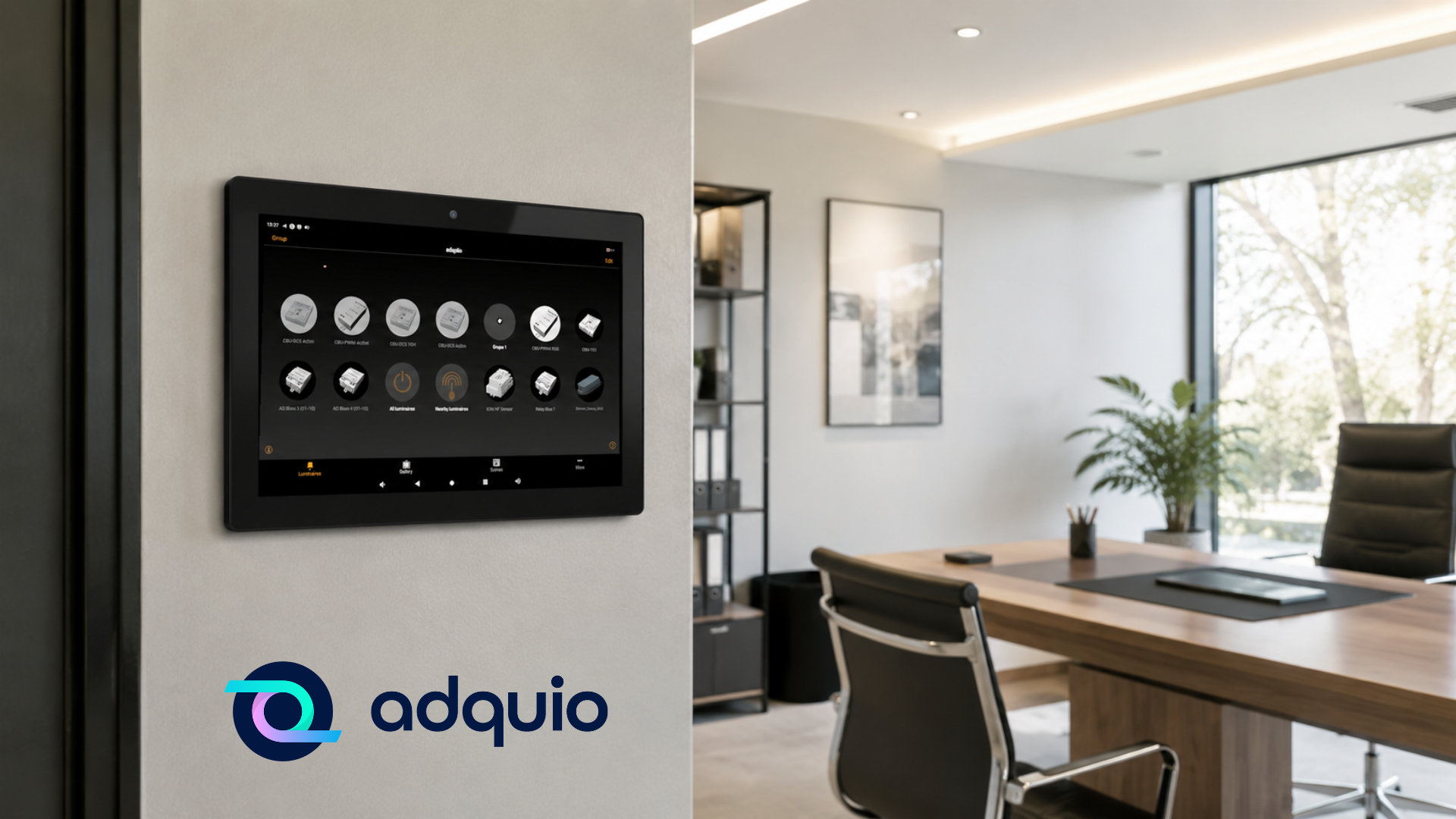
Imagine buying a smart lamp, thermostat or lock without having to worry about whether it is compatible with the system you already have.
Imagine devices from different manufacturers communicating through a common language.
Or using voice assistants from Apple, Google or Amazon without having to choose one brand for all your devices.
For years, achieving this has been one of the major challenges of smart buildings.
Each manufacturer developed its own technologies, applications and communications methods.
The result is a familiar problem: devices that work perfectly well on their own, but cannot always work together.
Matter was created to help address that problem.
Although initially focused particularly on smart homes, its possibilities are also relevant to hotels, offices, residential buildings and professional automation systems.
First, what is Matter?
Matter is an open communications standard designed to help smart devices from different manufacturers work together.
Put simply:
Matter is a common language for smart devices.
Think of two people who speak different languages.
Even if they want to collaborate, they need a way to understand each other.
Electronic devices face a similar situation.
A lamp may use one manufacturer’s system, a thermostat may come from another and a lock may have its own application.
Matter provides common rules for compatible devices to exchange information and commands.
For example, it defines standard ways to represent a light, a socket, a thermostat or certain sensors.
Compatible systems can therefore recognise the functions a device offers without necessarily needing a separate integration for every manufacturer.
The aim is to choose devices for what they do, rather than being limited to a particular brand.
Why was Matter created?
The smart device market has long been fragmented.
Imagine a home with ten connected devices.
The lights have one app.
The thermostat uses another.
The blinds need a third.
And the locks require a different platform.
When we want all those devices to participate in the same automation, we may find they are not compatible.
For example, we might want opening a door to switch on selected lights and adjust the temperature.
That sounds simple, but integration can become difficult when the devices belong to different ecosystems.
Matter was created to reduce these barriers.
The standard is developed by the Connectivity Standards Alliance, an international organisation whose members include many manufacturers and technology companies.
Apple, Google, Amazon and Samsung are among the companies supporting the ecosystem, alongside many device manufacturers.
The idea is that all can adopt the same basic communications rules.
This is a significant change.
Manufacturers can adopt a shared language, making it easier for buildings to accommodate equipment from different suppliers.
Which devices can use Matter?
The range of compatible devices has grown with successive versions of the standard.
Matter now covers many categories, including:
- Lighting and dimmers.
- Plugs and electrical devices.
- Thermostats and HVAC equipment.
- Blinds and solar shading systems.
- Locks.
- Temperature, motion and other sensors.
- Air quality equipment.
- Certain household appliances.
- Energy management systems.
- Electric vehicle chargers and other compatible energy equipment.
- Cameras and other devices added in recent versions.
This does not mean every product in these categories is automatically Matter-compatible.
Each manufacturer needs to implement the standard and the relevant functions.
Different ecosystems may also support different categories or versions.
The direction is clear: Matter is progressively expanding the technologies that can communicate through common rules.
How does Matter work? A simple explanation
Matter uses familiar communications technologies.
These include Ethernet, Wi-Fi and Thread.
Thread is a low-power wireless networking technology particularly useful for sensors and small smart devices.
Bluetooth can also be used during certain commissioning and configuration processes.
One important distinction helps explain this:
Matter is not the same as Wi-Fi, Bluetooth or Thread.
Wi-Fi and Thread transport information.
Matter defines how compatible devices interpret and use it.
Think of a telephone conversation.
The telephone network carries the voice, but the people speaking need a common language to understand the message.
Matter works in a similar way.
The network provides communication, while Matter defines the language the devices use.
Different Matter devices can therefore use different communications media and still belong to the same ecosystem.
An example: a home with devices from different manufacturers
Imagine a modern home.
It has smart lighting, HVAC, motorised blinds and electronic locks.
All these devices support Matter, but they come from different manufacturers.
A compatible controller can integrate their functions and use them in automation.
For example, a scene called “Leave home” could switch off selected lights, adjust HVAC and close the blinds.
If the locks and platform support it, the scene could also check door status.
The devices do not all need to be from the same brand.
These functions depend on each device’s capabilities, its Matter version and the platform controlling it.
The underlying principle is useful:
Users need devices that work together without having to understand every communications detail.
What does Matter have to do with building management?
This is where the wider possibilities begin.
We have used home examples because that has been a major area of Matter development.
Now consider an office building, hotel or residential complex.
These buildings use many devices:
Temperature sensors, presence detectors, thermostats, locks, lighting, blinds, HVAC and metering equipment.
Many of these systems traditionally use professional protocols such as BACnet, Modbus or KNX.
Others use specialist technologies, such as Casambi for lighting.
More Matter-compatible smart devices are also becoming available.
What happens when we want to bring all these elements into centralised management?
They need to share information.
Matter offers another way to connect compatible devices with existing management systems.
Matter does not, however, automatically replace a professional BMS.
A BMS may need complex supervision, automation, historical data, alarms and management of large installations.
Matter provides interoperability for the functions and devices covered by its standard.
The technologies can complement one another.
A practical example: a small hotel
Imagine a hotel with 40 rooms.
It has lighting, HVAC, blinds and various sensors.
Part of the installation uses professional automation equipment, while another part includes Matter devices.
The hotel wants a centralised system for managing all its installations.
With suitable integration, compatible Matter thermostats can provide temperature and setpoint information.
Sensors can supply environmental data.
Compatible blinds can receive commands from the control system.
All this information can be combined with lighting and the hotel’s other installations.
For example, when a room becomes unoccupied, the management system can adjust HVAC and carry out configured energy-saving actions.
The central system needs to understand each device’s information and operate its supported functions, whether the original technology is Matter, KNX or Modbus.
The building can work across the boundaries between technologies.
Can Matter replace KNX, Modbus or BACnet?
This is an important question for installers and integrators.
These technologies do not need to be treated as competitors where one must eliminate the others.
KNX, Modbus and BACnet have been used in professional installations for years.
They have extensive equipment ecosystems and address specific automation and supervision needs.
Matter was created with a different focus, particularly on interoperability between smart devices and platforms.
Each technology has its own characteristics, capabilities and applications.
Adding Matter to a building that already uses KNX or BACnet should not require replacing those systems.
Connecting them can be a more useful approach.
Imagine a building with KNX lighting and blinds, Modbus electricity meters and BACnet HVAC.
New Matter sensors or devices can be incorporated through a compatible gateway.
The building gains functions without rebuilding its existing installations.
Progress comes from helping new technologies work with the systems we already have.
A major benefit: less dependence on one manufacturer
A building can face limitations when all its devices depend on one proprietary technology.
A manufacturer may not offer the sensor we need.
We may want to use a device from another brand because it has more suitable features.
Or we may want to change the management platform while keeping installed equipment.
Open standards help reduce these difficulties.
Matter lets manufacturers implement shared functions, providing more choice.
This does not make every device’s advanced features universal.
A manufacturer may offer specific functions that Matter does not cover.
However, common control and monitoring capabilities make integration easier.
That is especially important for buildings expected to operate for many years.
Matter also supports different ecosystems
Another useful capability is sharing devices between compatible platforms.
For example, certain devices can be used through Apple Home, Google Home or Amazon Alexa, provided the equipment and platforms implement the required functions.
This gives users different ways to interact.
One person may prefer to control their home from a phone.
Another may use voice commands.
The installer may need a more advanced supervision interface.
The standard is also evolving to improve shared administration between systems.
Matter makes it easier, to an extent, to separate a physical device from the application used to operate it.
One building can offer different control options without requiring everything to come from the same manufacturer.
What about security?
Security matters whenever smart devices are connected.
Matter includes authentication, identification and encrypted communications mechanisms.
Its design requires devices to establish trust before exchanging certain commands and information.
This is especially important for locks, HVAC and other equipment affecting building operation.
Using Matter does not remove the need for cybersecurity practices.
Devices still need updates, permissions must be managed, networks protected and access by users and platforms controlled.
A secure standard provides a good foundation.
Building security also depends on how the whole installation is designed, configured and maintained.
Does Matter need a permanent Internet connection?
Not necessarily.
Matter is designed to support local communication between compatible devices and controllers.
Many functions can therefore run within the building’s own network without continuously sending commands to external servers.
For example, a local Matter controller can send a command to a compatible light through the internal network.
Some remote access functions, external services or voice assistants may still need Internet access.
Thread devices also need suitable network infrastructure, normally including a Thread border router.
It is therefore important to distinguish local control from cloud-dependent services.
A good architecture should keep essential functions operational if the external connection fails, provided local equipment remains operational.
Adquio MatterLink: the bridge between Matter and professional automation
At Adquio, we have long worked with a fundamental idea: buildings should not be limited by the protocols their equipment uses.
Our controllers integrate technologies such as Casambi, KNX, Modbus, BACnet and MQTT, creating systems where different devices can share information.
Matter adds another integration possibility.
We developed Adquio MatterLink to provide it.
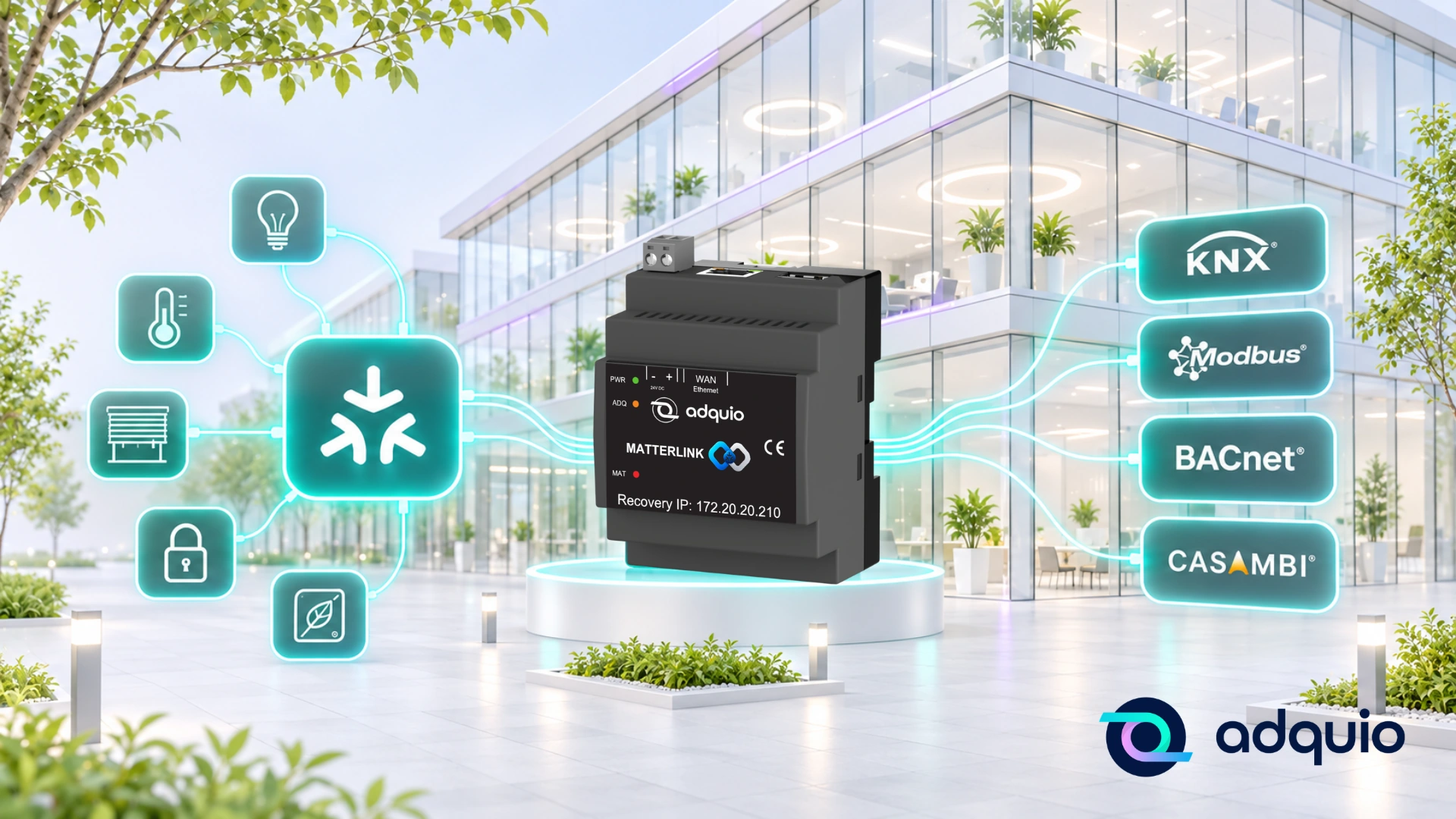
MatterLink is a bidirectional gateway that connects compatible Matter devices to the Adquio ecosystem and publishes selected Adquio functions to other Matter ecosystems.
This gives integration two directions:
We can bring Matter into Adquio and bring functions from an Adquio installation into the Matter ecosystem.
First direction: from Matter into Adquio
Imagine a Matter-compatible temperature sensor.
Through MatterLink, it can become part of an Adquio installation, with its values accessible through controller variables.
The temperature can be displayed, used in automation or included in HVAC strategies.
The same approach applies to other compatible device categories supported by the gateway.
Matter equipment can therefore participate in the building’s overall management.
Second direction: from Adquio into Matter
Now imagine the reverse.
A lighting installation is controlled through Casambi and integrated into Adquio.
We want to make some of its functions available to a compatible Matter ecosystem.
MatterLink lets us select Adquio variables and functions and represent them through its Matter bridge capability.
Selected commands and statuses can then be shared with compatible platforms.
This creates opportunities to give existing technologies new control options.
Publishing depends on the Matter device types and functions implemented by the gateway and the receiving ecosystem’s capabilities.
The underlying idea is powerful:
An installation does not need to have been built with Matter to share selected functions through Matter.
A complete example: Casambi, HVAC and Matter working together
Imagine a high-specification home with Casambi lighting.
HVAC uses Modbus.
Blinds are integrated through KNX.
The owner wants to add new Matter sensors and use selected controls from Apple Home.
How could this work?
First, Adquio controllers integrate Casambi lighting, Modbus equipment and the KNX installation through the corresponding gateways and protocols.
Next, Adquio MatterLink incorporates compatible Matter sensors.
Their values become available within Adquio.
Finally, we select the functions to publish to Matter.
For example, selected lights or controls can be represented through compatible Matter device types.
The receiving platform can use them according to the functions it supports.
Meanwhile, Adquio continues coordinating automation and providing professional supervision capabilities.
The result is an installation combining different technologies, making use of existing equipment and offering new ways to interact.
Casambi, KNX and Modbus remain in place and can now work with Matter.
Can Matter help manage large buildings?
Yes, but its role needs to be understood.
Matter adds interoperability possibilities, but it is not intended to replace every capability of a large-scale BMS on its own.
A hospital, airport or major shopping complex may require advanced supervision, redundancy, alarms, historical records and control of thousands of elements.
Matter can play a complementary role in those environments.
For example, it can support the integration of certain compatible sensor or device categories.
Or make selected professional installation functions available to other platforms.
Architecture must account for device numbers, security, operational requirements and actual equipment compatibility.
The benefit is in extending the available options while choosing the appropriate technology for each requirement.
What changes for installers and integrators?
Matter can create new opportunities.
More freedom to choose devices. Professionals can assess options from different manufacturers without depending exclusively on one proprietary technology.
Potentially simpler integrations. Standardised functions can reduce the need to develop specific connections for every product.
Better use of existing installations. Suitable gateways let professional technologies share functions with Matter.
New services. Integrators can offer extensions, automation and new control options using equipment already installed.
More long-term flexibility. Buildings can incorporate new technologies without necessarily replacing their entire infrastructure.
There are also responsibilities: check compatibility, maintain updates, protect communications and design architectures that continue to operate reliably.
Matter helps interoperability, while the integrator’s knowledge remains essential.
Is Matter the future of every building?
Matter is likely to become more common across many smart device categories.
The standard continues to evolve.
Recent versions have added capabilities related to cameras, energy management, device configuration and collaboration between ecosystems.
This can allow more equipment to participate in interoperable environments.
It does not mean every building will use Matter exclusively.
Existing professional technologies will continue to have important applications.
A useful future is one where Matter devices, KNX installations, Casambi lighting, Modbus equipment and BACnet systems can all participate in a common architecture.
Users can interact with the building simply, while professionals retain control of its operation.
The future of smart buildings depends on technologies working together
For too long, automation has been constrained by compatibility between manufacturers.
We wanted to add a device but discovered it could not communicate with the installation.
We wanted to improve a function but needed to replace equipment that still worked perfectly well.
Matter is an important step towards a different situation.
One where devices share functions through common rules.
And choosing a technology does not necessarily mean giving up others.
At Adquio, we share that approach.
We develop open solutions that integrate different technologies and make use of existing installations.
Adquio MatterLink connects Matter with professional automation in both directions.
A building becomes smarter when its technologies work together effectively.
Want to connect Matter devices to your existing installation?
Discover Adquio MatterLink and how to add new technologies while retaining those you already use.
Technologies change. Your building should not need to start again every time a new one appears.
Connect Matter to your installation
Tell us which devices and systems you need to integrate in your building.